

He loved the city, but more specifically, he loved Soho. That small warren of streets between Oxford Street, Shaftesbury Avenue, and Charing Cross Road. He loved the hot girls in London’s red light district.
Granted, over the past decade (and even before that) the area’s sleazy past had largely been whitewashed. In 2015 the police swooped down on the strip bars and peep shows of Tisbury and Walker’s Courts. All the girls and their pimps were led out into the street in handcuffs, photographed by the press who had presumably been tipped off in advance.
He remembered those streets from years back when he had first ventured out into London alone as a 17 year-old. The barking market traders on Berwick Street. The dingy porn shops and cinemas along Rupert Street. The garish orange and pink stars with girls’ names written on them in marker pen affixed to open doors that led to filthy staircases up to bedroom where pleasure was to be obtained for twenty quid or less.
Much of this had been swept away now. Gentrification had exerted its totalitarian grip, as it had on other red light zones across the world from NYC to Berlin. But still, a resonance remained in Soho and, rather like the addict who will attempt to inject even the tiniest amount of heroin (mixed with water) into his veins, he would wander the streets endlessly and obsessively, looking out for the remnants of sleaze.
There was only one bona fide Soho strip club left these days, on Dean Street. (Well, there were a couple of others. But the Dean Street address was the best of them). This one had the greatest sense of the ‘old Soho’ about it. A commingling of seediness with London-Euro bonhomie and banter.
This place, this Sunset Strip, became a haunt for him. Actually, he had passed it for many years without ever entering. Girls in garish bikinis and lingerie extracting drinks from city guys in pinstripe. But when he did finally pay a visit, he discovered the true glory of the place: the neon gloom of the room below, where girls would dance on a stage to all kinds of music—rock, pop, techno, Latin ballads and more.
This place, this theatre of the erotic and the banal, had became something of a refuge for him—a secular church, where men would worship the naked female form rather than any god. Here, a strange mixture of deadbeats, Essex flash, cubicle workers, alcoholics and old-timers would sit on dirty, red velvet cinema seats for hours at a time, drinking, and watching Misha and Angelika and Natasha and Eve take it in turns to dance to their favourite songs.
For him the place transcended mere sexual desire. In fact, by now it had very little to do with sexual desire at all. It had more to do with the strange, hypnotic feeling the club gave him. Entering Sunset Strip was like walking into a dream. A space where all responsibility was abdicated. Where he willingly sank into a role which was undesirable to most, but strangely relaxing all the same. It was a role he had been auditioning for his entire life—that of dirty old man.
Well, who cares what anyone thinks? We’re all in this together. We all sit beside one another in these velvet streets looking at these girls, and we are all thinking the same things.
Here, in this place where married men paid for dances with girls twenty years younger than them or more, there was no pretence about the nature of sexuality, about the way men and women relate. About monogamy. And the girls were in on it too—of course they were.
It was the most honest place he had ever visited in his life.
It was an honesty that made him somewhat nostalgic for a time when things were clearer. In 1984 by George Orwell there is a scene where Winston Smith happens upon an antique shop in a proletariat part of town. In it he finds a beautiful notebook, and recalls with sadness a time when people were permitted to write things down—to record their thoughts. While the comparison is not an exact one, in Sunset Strip he recognised a terrain where gender politics had not intruded, a rare place where both women and men were honest with themselves and each other, momentarily at least.
More than anything, though, he enjoyed the place place as somewhere to relax. To sit back and to allow his mind to wander. Yes, the girls would come and ask him if he wanted a ‘private dance’. Mostly he would refuse. After all, he wasn’t there to look at them—not really.
He was there to look at himself.
The Strip
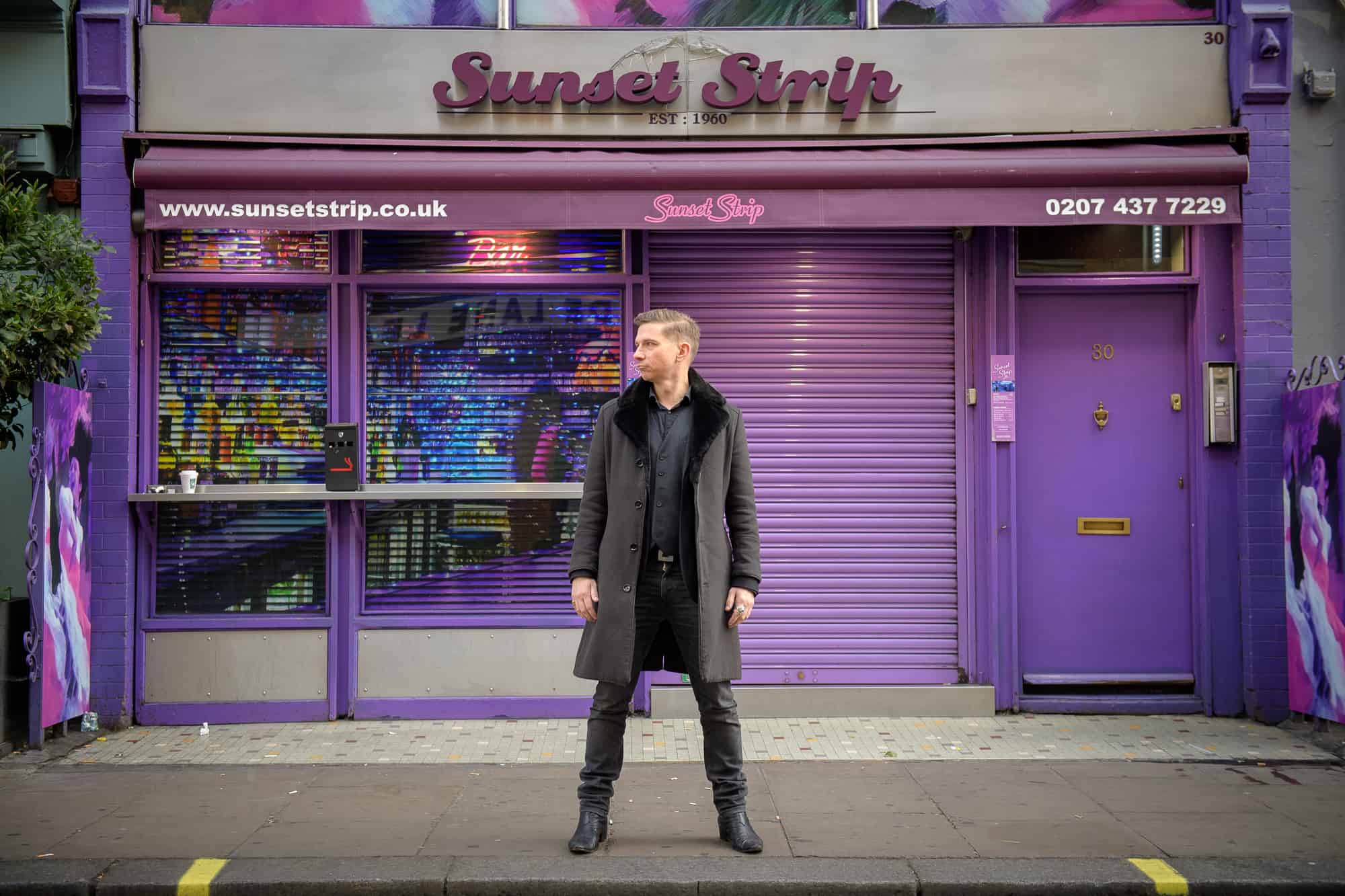
Sunset Strip has existed for 60 years. They tell him it’s been quiet. One day, perhaps, the place will be torn down. The neons downstairs will be removed and discarded, the low stage ripped out, the mirrored ‘private dance’ area dismantled. Outside, the purple paintwork and the mural of The Folies Bergère will be expunged. The building will instead be leased to a coffee chain, or perhaps a hipster Mexican restaurant selling overpriced tacos, or a noodle place or something like that.
But what can never be removed are the collective dreams that have been dreamed in that mysterious, transcendental place, because these will live on in the psyches of both the girls and the punters. Erotic dreams that never die, dignified—despite what the doubters may suspect—by mutual respect, honesty, even love.
When they take away physical places like strip clubs, porn cinemas and other naughty places they don’t merely remove buildings, fixtures and fittings. They also destroy modes of interaction between human beings.
One mode of interaction that is in danger is that of the dancer and paying customer. Granted, it may not be a mode that is universally approved of. But it is one where genuine and positive interactions occur, where memories and dreams are fashioned, and hope and inspiration are transmitted.
As these things inevitably recede from memory, our future looks increasingly monochrome.
To read more about modern relationships, go here.
If you liked this sign up for my daily email. You also get as free copy of my new online course Renegade Playbook.






Precisely what dream is fashioned, and which hope transmitted, through the medium of a private dance?
There is a degree of poetic license in this piece, as I’m sure you’ll appreciate.
Troy.